by Kerri MacFarlane | Jan 15, 2026 | Alcohol Free, Alcohol Relapse, Big Alcohol, Blog, Early Sobriety, Science and alcohol
The Numbers Don’t Lie: Only 54 Percent of Adults Drink Alcohol
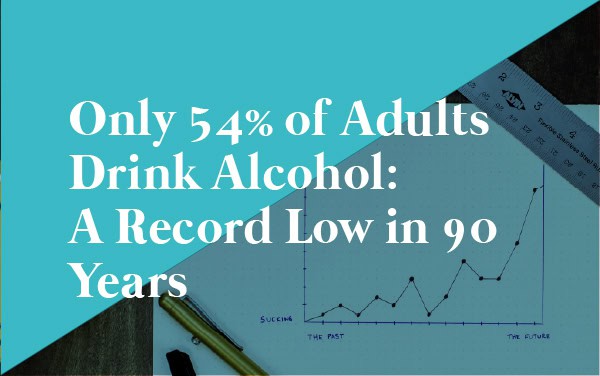
Quitting alcohol can feel isolating, like you’ll be the only one not drinking. But here’s the truth: only 54 percent of adults drink alcohol, according to a new Gallup poll. That’s the lowest number in nearly 90 years, and it proves you’re not as alone as you might think.
A recent Gallup poll reported by CBS News found that only 54 percent of adults drink alcohol — a record low in nearly 90 years of polling.
In other words, almost half of Americans don’t drink at all.
Why Fewer Americans Are Drinking
This shift didn’t happen overnight. The poll highlights two major drivers:
- Health Risks Are Impossible to Ignore. In 2015, only 28% of Americans believed moderate alcohol use was harmful. By 2025, that number had nearly doubled to 53%. Science has caught up with culture, and the messaging is clear: alcohol is a carcinogen, a risk factor for over 100,000 cancer cases annually in the U.S., and a contributor to around 20,000 cancer deaths each year.
- Generational Change. Younger Americans are leading the way in questioning alcohol’s role in their lives. Social norms are shifting, and the alcohol industry is feeling the pressure.
Podcaster and speaker Scott Galloway recently told AB InBev’s board, bluntly:
“You’re fcked—and you’re double fcked.”
People are drinking less overall, and younger generations—the industry’s “future customers”—are opting out entirely.
The Numbers Don’t Lie: Only 54 Percent of Adults Drink Alcohol
Some of the most telling stats from the Gallup report include:
When Recovery Elevator launched more than ten years ago, over 60% of Americans reported drinking. That number has steadily declined, reflecting a real and measurable cultural shift.
The Numbers Don’t Lie: Only 54 Percent of Adults Drink Alcohol
This is more than just a poll. It’s proof that the cultural tide is turning.
For years, communities like Recovery Elevator have been sharing a simple truth: alcohol is not the harmless social lubricant we’ve been sold. It’s toxic. It takes lives. And choosing not to drink isn’t weird—it’s wise.
The more mainstream outlets cover this, the more people start to question their relationship with alcohol. What used to be “radical” is becoming normal. And if you’re sober, sober-curious, or just taking a break, you’re not swimming against the current anymore. You’re part of a growing wave.
You’re Not Alone: Nearly Half of Americans Don’t Drink Alcohol
If you’ve ever told yourself, “I’ll be the only one not drinking,” remember this: only 54 percent of adults drink alcohol — which means nearly half of Americans are right there with you.
This isn’t fringe. This isn’t rare. It’s becoming the norm.
- I don’t drink.
- Odette doesn’t drink.
- And 46% of Americans don’t drink either.
The myth of “everyone drinks” has officially been dismantled.
Final Thoughts: What the Decline in Alcohol Use Means for Sobriety
Ten years ago, none of us could have predicted this. But here we are: fewer Americans are drinking, the science is loud and clear, and the alcohol-free movement is gaining momentum.
If you’re on this path, know that you’re not alone. Millions of people are making the same choice, and together, we’re reshaping culture.
The question isn’t “Why don’t you drink?” anymore. It’s “Why would you?”
👉 Join the Movement: Thinking about changing your relationship with alcohol? Café RE is a private, supportive community for anyone who wants to ditch the booze and live a healthier, more connected life.
Author: Paul Churchill, founder of Recovery Elevator.
by Kerri MacFarlane | Jan 14, 2023 | Alcohol Free, Big Alcohol, Early Sobriety, Expectations, Resources
406 episodes of the Recovery Elevator Podcast were released before there was an intro with the main message being addressed to Big Alcohol. Why do you think that is? That’s a lot of Mondays to not tell Big Alcohol what we think, (or where to stick it ?). Why wasn’t this addressed before episode 407: A Message to Big Alcohol…?
Well, like Paul said…we have limited time together and it feels like a better use of our time discussing how to build a new life that no longer requires alcohol, instead of fighting Big Alcohol, or fighting the past.
In fact, although you may not feel like it right now…if you keep moving forward, if you don’t quit quitting, and you keep doing the next right thing, one day at a time…you may just find yourself thanking Big Alcohol for giving you the life you have today. Crazy to imagine, right? I know it was for me. But it absolutely is true today. I am thankful for where my struggle with Big Alcohol has led me.
So here we are…let’s call out a couple of things regarding Big Alcohol, and maybe, there is a way we can work together.
First off, let’s get real for a second Big Alcohol. We both know your business model doesn’t survive off normal drinkers. Your lights are on, your doors are open, salaries are paid because of problematic drinkers…aka: alcoholics.
This is called the 80/20 rule in business and for Big Alcohol, it’s probably a 90/10 rule. This means that 90% of revenues are coming from 10% customers.
Let’s take a normal drinker. This is someone who buys a six pack of Coors Light, drinks 2-3 beers, and the remaining 3-4 cans sit in the refrigerator in the garage for the next couple weeks or months.
That is one type of customer.
Then take the alcoholic. This is someone who buys a 12, 18, 24, or 30 pack of Coors Light… daily. Where do you think your revenue is coming from? This question is rhetorical because they already know this.
Big Alcohol, we bring this up because there needs to be accountability on your part…and here’s some reasons why:
◾️Yes, it’s the individual who is drinking excessively, but the data and science support that alcohol is the most dangerous and addictive drug on the planet.
It kills more people each year than every other drug combined. An estimated 40-75% of occupied hospital beds have underpinnings to alcohol. In 2010, a Doctor named Dr. David Nutt, hired by the British government, was tasked to put a harm score on the world’s 20 most addictive drugs. Alcohol came in at #1. In 1958 the American Medical Association classified alcoholism as a disease.
◾️No amount of alcohol consumed is beneficial to the consumer.
This a myth that you, Big Alcohol, tries to perpetuate. In the Mid 2010’s the government funded agency the NIAAA (National Institute on Alcohol Abuse and Alcoholism) performed a study to see if alcohol consumption was good for you.
The answer was…YES. Say whattttt?? ? However, it then became known the study was funded by Big Alcohol. No surprise the answer was yes! ?
In reality, no quantity of ethanol is good for you. The Huberman Lab Podcast has a fantastic episode about the effects of alcohol on your mind and body. The Stanford University Neuroscientists confirmed that no amount of alcohol is good for you.
◾️And let’s talk trash, garbage or waste.
A couple months ago Paul had new brakes installed on his vehicle and he rode his bike home from the mechanic after dropping off his truck. He took a scenic county road home for about 7 miles. While hugging the side of the road he was astonished by the amount of empty alcohol containers that littered the shoulder.
Keep in mind, this was in the part of the grass that had been maintained. Paul said he guessed there was triple or quadruple the amount of empty bottles and cans in the taller grass. (Now to be fair, he did see empty gatorade bottles, and trash that was not related to alcohol, but he said if he had to guess it was a 10/1 ratio.). Paul estimated there was an empty alcohol container every 100 feet (and that’s a safe estimate). With some easy math that put 52 bottles, or cans, every mile totaling over 350 pieces of trash on his 7 mile bike ride. That figure would be way higher if one were to walk through the taller grass.
This past October Paul did a retreat in Peru. One of their tasks was to pick up trash around a sacred temple about 20 miles outside of Cusco, which once was the capital of the Inca Empire. They filled about 4 trash bags, and again about a 10/1 ratio of alcohol containers to other trash.
Big Alcohol’s footprint is all over the globe; societal wreckage, physical disease, and in the form of excessive trash.
As human beings there is a goal that many of us share. That is to make this world a better place. ??
Big Alcohol, let me ask you this question, are you making the world a better place?
What impact are you having on society? On the fabric of family systems? Are you adding or subtracting to this world? Are you a net benefit? Or a net drain? What do you stand for Big Alcohol? Are you okay with your customers discarding your product waste into nature? Into my backyard? Into your backyard? Big Alcohol, your name, your brand, your message is on these containers that end up in our streams, rivers, and oceans. By all concerns you are still tied to the product, but you are not shouldering the burden after the monetary transaction has taken place.
This. Needs. To. Change.
As we all work on cleaning up our internal wreckage and chaos it’s time that you, Big Alcohol, start doing the same.
We here at Recovery Elevator are calling you out, Big Alcohol, to lean up your mess. A disproportionate amount of trash in nature is yours. It’s the RIGHT thing to do – to pick it up. We have a yearly service project at Recovery Elevator, and we’d love your help. Maybe take 1/2 a percentage of your marketing budget and help us out.
Big Alcohol, if you want to work with us, we’re open to it. Our email address is info@recoveryelevator.com.